
The Room Incident: Deliberation Secrecy and Executable Requests in R 3/24
The Enlarged Board of Appeal clarifies that a request to start an inventive step analysis from a specific prior art document is merely an argument. It also addresses a bizarre intrusion into a Board's deliberation room.

A request to uphold an appeal on the basis of a specific piece of prior art is merely an argument, not a legally binding request under Rule 104(b) EPC.
In R 0003/24, the Enlarged Board of Appeal dismissed a petition for review arising from a highly unusual set of circumstances, including an opponent's representative walking into the Technical Board of Appeal's deliberation room, while clarifying the strict boundaries of fundamental procedural defects.
The prior art pivot
The underlying appeal (T 1656/17) concerned a video camera patent. The opposition division had revoked the patent for lack of inventive step, selecting document D5 as the closest prior art. On appeal, the Technical Board of Appeal instead selected document D10 as the starting point and dismissed the appeal on that basis, without deciding on the D5 combination.
The patent proprietor filed a petition for review, arguing that the Board's failure to issue a decision starting from D5 constituted a fundamental procedural defect under Article 112a(2)(d) EPC and Rule 104(b) EPC. The petitioner contended that the Board had failed to decide on a relevant request and had not explained why D10 was a better starting point than D5.
Arguments versus executable consequences
The Enlarged Board firmly rejected this framing. The petitioner's request that the decision be set aside because the patent was inventive over D5 was not a "request" within the meaning of Rule 104(b) EPC. The EBA clarified that requests must be directed to executable legal consequences sought (reasons 3.1).
The executable consequence was solely the setting aside of the decision under appeal. The reliance on D5 was merely an argument advanced to achieve that end. Because the Board found a lack of inventive step starting from D10, logic dictated there was no need to assess other items of prior art, nor to explain why a specific item was selected as the closest prior art.
The exhaustive nature of procedural defects
The petitioner also argued that the Board's pivot to D10 violated the Rules of Procedure of the Boards of Appeal. The EBA dismissed this, affirming the principle from R 0012/23 that Article 112a(2)(d) EPC is not a catch-all clause for procedural defects. Rule 104 EPC exhaustively defines exactly two defects, and a violation of the RPBA is not among them (reasons 3.2).
The deliberation room intrusion
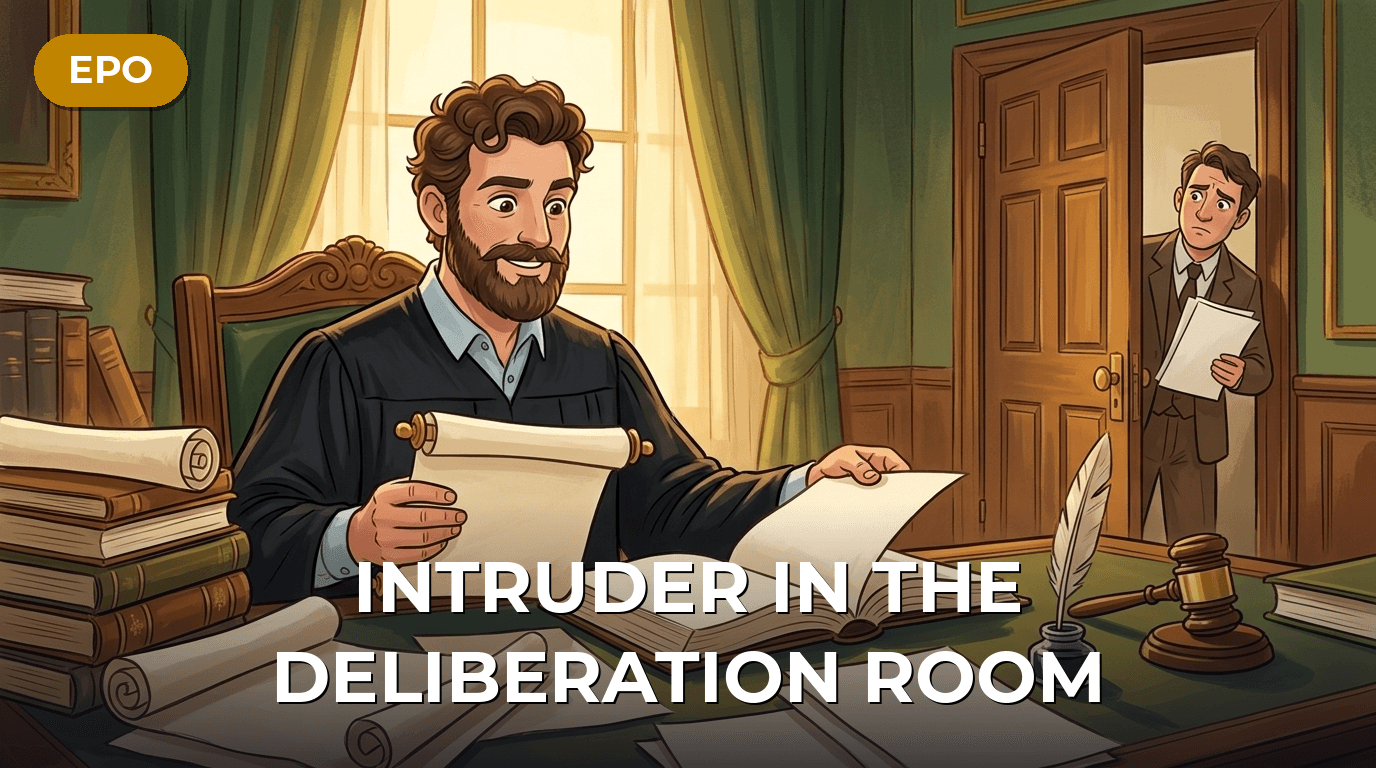
The most dramatic element of the petition concerned the "room incident". During an interruption for deliberation in the oral proceedings, the opponent's representative entered the room, closed the door, and asked about the timetable. The chair immediately asked him to leave.
The petitioner argued this breached the secrecy of deliberations under Article 19(1) RPBA 2020, inherently violating the right to be heard (Article 113(1) EPC). The petitioner insisted that any third-party presence in the deliberation room constitutes a per se violation of deliberation secrecy, irrespective of demonstrable harm.
Secrecy and sanctions
The EBA held that a breach of deliberation secrecy is not a fundamental procedural defect under Article 112a(2)(d) EPC. The remedy for such a breach is disciplinary action against board members by the Administrative Council, not a petition for review (reasons 4.1.2). The Board itself could not have handed down a decision pronouncing a remedy or sanction for its own secrecy breach.
Furthermore, because the representative was immediately asked to leave, he could not have obtained knowledge of the deliberation. If the board members are unaware of anybody overhearing their deliberation, they cannot be influenced in their decision-making. Thus, the board members' impartiality could not be impaired, and no violation of the right to be heard occurred (reasons 4.3.1).
Practical implications
This decision reinforces the narrow scope of the petition for review mechanism. Practitioners must distinguish between formal requests for executable legal consequences (such as maintaining a patent as granted) and the substantive arguments supporting them (such as the choice of closest prior art). A board's failure to address a specific prior art starting point does not constitute a failure to decide on a request under Rule 104(b) EPC.
Additionally, the EBA confirmed that Article 112a(2)(d) EPC is strictly limited to the defects enumerated in Rule 104 EPC. Procedural irregularities, even startling ones like an opposing representative wandering into the deliberation room, will not sustain a petition for review unless they demonstrably deprive a party of the opportunity to comment on the essential legal and factual reasoning on which the decision is based.
Sources
Further Reading
Articles related to the topics covered above.

Reviewing Discretion: R 0010/24 on Manifestly Incorrect Non-Admission
The Enlarged Board of Appeal confirms that discretionary non-admission of requests under the RPBA is subject to review for 'manifestly incorrect' application, resolving a divergence in its jurisprudence.

The Sentence G 1/25 Actually Wants Deleted
Unclaimed embodiments may stay. The Enlarged Board of Appeal defines when an inconsistency between amended claims and the description requires adaptation, and names the statement that has to be removed.

Independent Lines of Reasoning: R 0018/23 on Causality in Petitions for Review
The Enlarged Board of Appeal clarifies how a procedural violation interacts with a decision resting on multiple lines of reasoning, emphasizing the lexical choices of the Technical Board of Appeal.