
Granular Equivalence and Complete Redesigns: The Düsseldorf Local Division on Stroller Mechanics
The Düsseldorf Local Division confirms that extending an equivalence argument does not require a Rule 263 RoP amendment. Furthermore, proving equivalence requires a feature-by-feature functional analysis rather than a broad focus on the objective task.

When a claimant realises midway through an infringement action that a literal reading of a patent claim might fail, the natural reflex is to pivot to the doctrine of equivalence. In stroller mechanics, where components like locking pins and wheel bearing assemblies can often be inverted without losing functionality, this pivot seems especially tempting. But as the Düsseldorf Local Division recently demonstrated in UPC_CFI_334/2025, shifting from a literal infringement theory to an equivalence argument requires more than just pointing out that the accused device achieves the same overall result.
Does expanding an equivalence argument require leave under Rule 263 RoP?
The procedural history of the dispute between Wonderland Nurserygoods and Cybex over EP 1 905 615 offers a helpful clarification on case management. The claimant initially asserted that the challenged strollers infringed two features of the swivel locking device by equivalent means, while all other features were infringed literally. Later in the written procedure, the claimant sought to introduce an alternative equivalence argument for two additional features, namely the location of the cavity and the clasping mechanism. Assuming this constituted an amendment to its case, the claimant filed an application for leave to change its claim pursuant to Rule 263 RoP. The judge-rapporteur rejected the application, clarifying that Rule 263 RoP does not apply to the extension of an equivalence argument. The panel subsequently upheld this order, confirming that introducing a new equivalence theory for existing features is an argument rather than a formal change of claim.
How did the Düsseldorf Local Division apply the Hague equivalence criteria?
Turning to the substance of the equivalence assessment, the panel explicitly endorsed the criteria previously set out by the Local Division The Hague. The judges noted that these criteria form a coherent whole and are suitable for examining patent infringement by equivalent means. The claimant had argued that the accused strollers simply reversed the design of the claimed swivel locking device. For instance, the claimant contended that it makes no technical difference whether the locking pin is disposed on the wheel bearing assembly or on the seat. The Court set a stricter standard. It held that to determine technical equivalence, a claimant must not focus solely on the objective task of the patent in suit. Instead, the claimant must demonstrate the function of each exchanged feature in achieving this objective and explain why the variation essentially performs the same function.
Why does a complete redesign defeat the obviousness of an equivalent element?
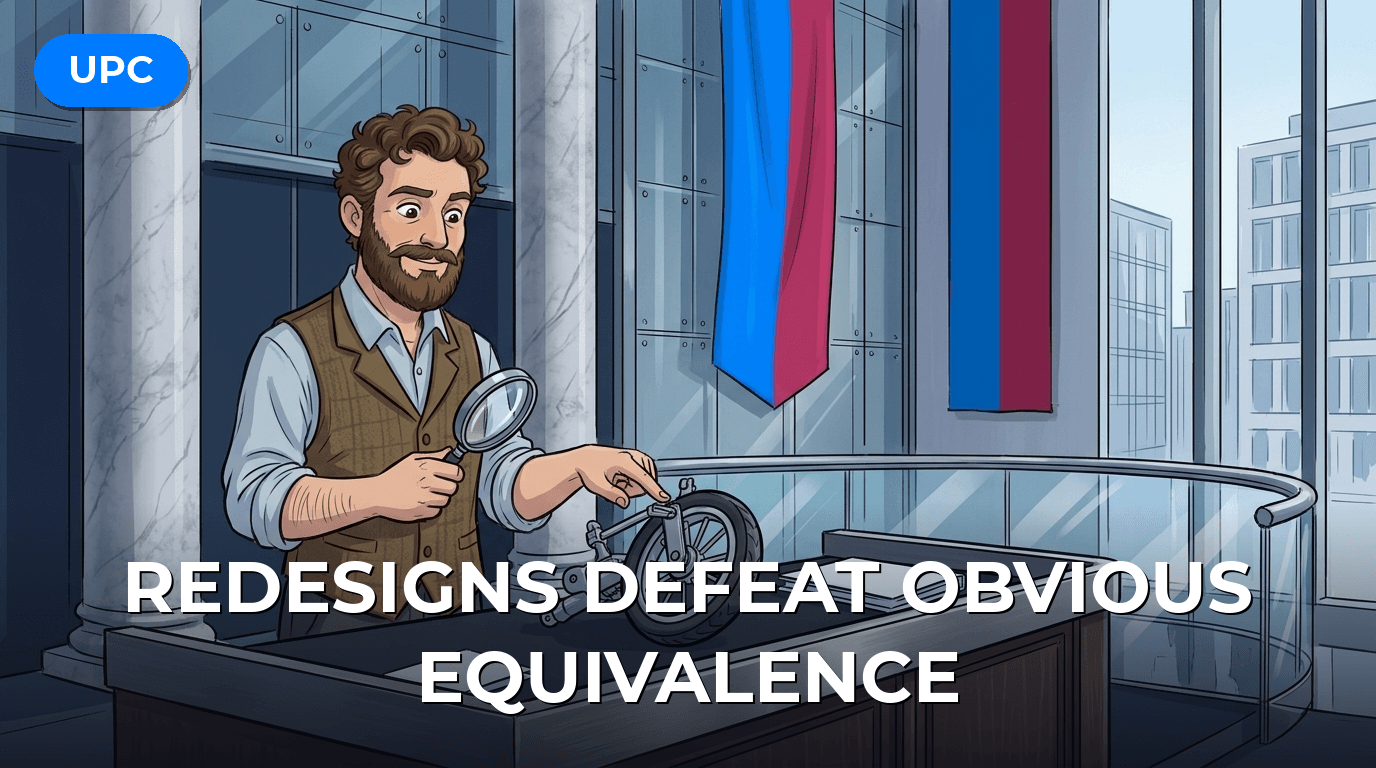
The panel further tightened the requirements for proving equivalence by addressing the perspective of the skilled person. In cases where an accused product achieves the same result through a reversed or heavily modified architecture, claimants often argue that the substitution would be immediately apparent. The Düsseldorf Local Division rejected this assumption for complex mechanical rearrangements. The Court established that it is generally not obvious to a skilled person how to apply the equivalent element if a complete redesign of the claimed device is required. Because the accused strollers relocated multiple interacting components, including the operating member and the cavity containing the clasping mechanism, the panel concluded that the variation went beyond a simple substitution.
What must claimants prove when asserting equivalence after this order?
For practitioners preparing infringement actions at the Unified Patent Court, this decision mandates a highly granular approach to equivalence. It is no longer sufficient to argue that an accused embodiment merely reverses the claimed arrangement to achieve the same overall objective task. Litigators must break down the technical effect of the variation feature by feature. If you assert that placing a locking pin on a seat is equivalent to placing it on a wheel bearing assembly, you must explicitly demonstrate the specific function of that exchanged feature and detail why the new location essentially performs the same function. Furthermore, if the alleged equivalent requires a complete redesign of the claimed device, claimants should anticipate a strong defence that the variation would not have been obvious to the skilled person.
Sources
Further Reading
Articles related to the topics covered above.

Unsubstantiated License Defenses and Accessory Liability: The Mannheim Local Division on EP 2 563 695 B1
The Mannheim Local Division clarifies the strict substantiation requirements for license defenses based on parallel national proceedings. The decision also applies the Philips v. Belkin standard to statutory corporate directors.
Late Arguments and Intermediary Liability: The Milan Local Division on EP 3 960 072 B1
The Milan Local Division clarifies the admissibility of late claim construction arguments in provisional measures and establishes the liability of EU Authorised Representatives under the Medical Devices Regulation.

Fee Reimbursements and Parallel Filings: Two Divisions Apply Rule 370.9 RoP
When an infringement action settles early, the standard 50% fee reimbursement is not guaranteed. Four coordinated orders from the Paris Central Division and Mannheim Local Division demonstrate how complex parallel filings reduce the refund.